Artificial intelligence (AI) requires extreme computational horsepower, but Analog Devices is cutting the power cord from AI insights. The MAX78002 is a new breed of AI microcontroller built to enable neural networks to execute at ultra-low power and live at the edge of the IoT. This product combines the most energy-efficient AI processing with Analog Devices' proven ultra-low-power microcontrollers. Our hardware-based convolutional neural network (CNN) accelerator enables battery-powered applications to execute AI inferences while spending only microjoules of energy.
The MAX78002 is an advanced system-on-chip featuring an Arm Cortex-M4 with FPU CPU for efficient system control with an ultra-low-power deep neural network accelerator. The CNN engine has a weight storage memory of 2MB, and can support 1-, 2-, 4-, and 8-bit weights (supporting networks of up to 16 million weights). The CNN weight memory is SRAM-based so that AI network updates can be made on the fly. The CNN engine also has 1.3MB of data memory. The CNN architecture is highly flexible, allowing networks to be trained in conventional toolsets like PyTorch and TensorFlow, then converted for execution on the MAX78002 using tools provided by Analog Devices.
In addition to the memory in the CNN engine, the MAX78002 has large on-chip system memory for the microcontroller core, with 2.5MB flash and up to 384KB SRAM. Multiple high-speed and low-power communications interfaces are supported, including I2S, MIPI CSI-2 serial camera, parallel camera (PCIF), and SD 3.0/SDIO 3.0/eMMC 4.51 secure digital.
The Arm Cortex-M4 with FPU processor (CM4) is ideal for AI system control. The architecture combines high-efficiency signal processing functionality with low power, low cost, and ease of use.
The Arm Cortex-M4 with FPU DSP supports single instruction, multiple data (SIMD) path DSP extensions, providing:
- Four parallel 8-bit add/sub
- Floating point single precision
- Two parallel 16-bit add/sub
- Two parallel MACs
- 32- or 64-bit accumulate
- Signed or unsigned data with or without saturation
The addition of a 32-bit RISC-V coprocessor (RV32) provides the system with ultra-low power consumption signal processing.
The CNN accelerator consists of 64 parallel processors with 1.31MB of SRAM-based storage. Each processor includes a pooling unit and a convolutional engine with dedicated weight memory. Four processors share one data memory. These are further organized into groups of 16 processors that share common controls. A group of 16 processors operates as a peripheral to another group or independently. Data is read from SRAM associated with each processor and written to any data memory located within the accelerator. Any given processor has visibility of its dedicated weight memory and the data memory instance it shares with the three others.
The features of the CNN accelerator include:
- Data storage
- 1.31MB SRAM-based data storage
- Configured as 20Kx8-bit integers x64 channels or 80Kx8-bit integers x4 channels for input layers
- Input data format – 8-bit signed values
- Selectable output data format – 8-bit signed integer or 32-bit signed integer for last layer
- Arm AMBA APB accessible
- Hardware CNN results data unload assist
- Weight storage
- SRAM based with selectable data retention mode
- Configurable from 2M 8-bit integer weights to 16M 1-bit logical weights
- Optional 4x processing mode splits each weight memory into four parallel memories with a common address generating 4x the number of masks each cycle
- All processors include the following dedicated weight storage:
- 1x processing mode
- 4096x9x8-bit weights
- 8192x9x4-bit weights
- 16384x9x2-bit weights
- 32768x9x1-bit weights
- 4x processing mode
- 4x1024x9x8-bit weights
- 4x2048x9x4-bit weights
- 4x4096x9x2-bit weights
- 4x8192x9x1-bit weights
- 1x processing mode
- The first processor in each x16 includes additional weight storage for input layer processing:
- 1x processing mode
- 1024x9x8-bit weights
- 2048x9x4-bit weights
- 4096x9x2-bit weights
- 8196x9x1-bit weights
- 4x processing mode
- 4x256x9x8-bit weights
- 4x512x9x4-bit weights
- 4x1024x9x2-bit weights
- 4x2048x9x1-bit weights
- 1x processing mode
- Programmable per x16 processor weight RAM start address, start pointer, and mask count
- Arm AMBA APB accessible
- Optional weight load hardware assist for packed weight storage
- 128 independently configurable layers (per x16 processor)
- Programmable start layer – any of the 128 layers
- Linked layer mode allows arbitrary nonsequential layer execution
- Configurable per layer parameters
- Processor and mask enables (16 channels)
- Input data format – byte-wide input data or 4x8-bit wide input data (x16 processors 0, 4, 8, or 12 only)
- Per layer data streaming
- Up to eight simultaneous streaming layers – available for the first eight layers
- Optional FIFO input data paths (first layer only)
- Selectable streaming termination layer – transition to nonstream processing mode
- Programmable per stream configuration
- Stream start – relative to prior stream
- Three stream processing delay counters – two column counters for noninteger ratios, 1-row delta counter
- Data SRAM circular buffer size
- Programmable input data size (separate row, column fields)
- Programmable row and column padding – 0 to 3 bytes
- Configurable number of input channels – 1 to 1024
- Configurable number of output channels – 1 to 1024 (determined by the kernel count value)
- Selectable kernel bit width size (1, 2, 4, or 8)
- Selectable kernel SRAM pointer start address and count
- Optional in-flight input image pooling
- Pool mode – none, maximum, or average
- Pool size – 2x2 to 16x16 with independent row and column counts
- Pool dilation – 0 to 15
- Programmable stride – 1 to 4 common row/column stride value
- Data SRAM read pointer base address
- Configurable read pointer increment value for flexible input channel access
- Data SRAM write pointer configuration
- Base address
- Independent offsets for output channel storage in SRAM
- Programmable stride increment offset
- Bias – 8192 8-bit integers with an option for 1024 10-bit integers using multiple x16 processors
- Optionally configurable as 4x2048x8-bit bias for 4x mode (with an option for 10-bit bias using multiple x16 processors)
- Pre-activation output scaling – direction (up/down) and 0 to 15-bit shift magnitude
- Output activation – none, ReLU, absolute value
- Pass-through mode allows input data to be passed directly through to the output with programmable data relocation.
- Element-wise operations (add, subtract, XOR, OR) with optional convolution – up to 16 elements
- Deconvolution
- Flattening - for MLP processing
- Depthwise convolution
- Simple logic modes support single mask bit +1/-1, 0/-1 modes
- No mask mode supports convolutions with a fixed mask value of 1
- Processing
- 64 parallel physical channel processors
- Organized as 4 x 16 processors
- 8-bit integer data path with an option for 32-bit integers on the output layer
- Per channel processor enable/disable
- Expandable to 1024 parallel logical channel processors
- Configurable 3x3 or 1x1 2D kernel size
- Configurable 1D kernel size to 1x9
- Full-resolution sum-of-products arithmetic for 1024 8-bit integer (data and weight) channels
- Two maximum operating frequency modes – up to 50MHz in nonpipelined mode or up to 200MHz in pipeline mode
- Up to 16 output channels per clock processing rate
- Conditional execution allows early layer termination and branching based on the programmable address and/or data and/or count match
- 64 parallel physical channel processors
- Input layer maximum input size
- 20KB, 64 channels, non-streaming, APB I/F
- 80KB, 16 channels, non-streaming, APB I/F
- 80KB, 4 channels, non-streaming, FIFO I/F
- 2048x2048 bytes, 4 channels, streaming, FIFO I/F
- Hidden layers maximum input size
- Up to 20KB per channel, x64 channels, nonstreaming
- 20KB can be split equally across 1 to 16 logical channels, nonstreaming
- 4MB per channel, x64 channels, streaming
- 4MB can be split equally across eight layers, streaming
- Optional interrupt on CNN completion and FIFO full and empty statuses
- User accessible BIST on all internal memories
- User accessible zeroization of all internal memories
- Single-step operation with full data SRAM access for CNN operation debug
- Power management
- Independent x16 processor supply enables
- Independent x16 processor mask retention enables
- Independent x16 data path clock enables
- Functional APB clock gating with per x16 processor override – registers clocked only during APB write access.
- CNN clock frequency scaling (divide by 2, 4, 8, or 16)
- Chip-level voltage control for power-performance optimization
- Input data row buffer memory (TRAM)
- Organized as 12Kx16 or optionally as 4x3Kx16 in read-ahead mode
- Programmable per layer TRAM read/write pointer start and rollover values
- Automatically allocates memory based on the programmed number of input channels
- Read ahead input processing mode allows the next input data byte to be preprocessed while the current input byte output channel generation is active.
The DVS controller works using the fixed high-speed oscillator and the VCOREA supply voltage to optimally operate the Arm core at the lowest practical voltage. The ability to adaptively adjust the voltage provides a significant reduction in dynamic power consumption.
The DVS controller provides the following features:
- Controls DVS monitoring and adjustment functions
- Continuous monitoring with programmable monitor sample period
- Controlled transition to a programmable operating point
- Independent high and low operating limits for safe, bounded operation
- Independent high, center, and low operating range delay line delay monitors
- Programmable adjustment rate – when an adjustment is required
- Single clock operation
- Arm peripheral bus interface provides control and status access
- Interrupt capability during error
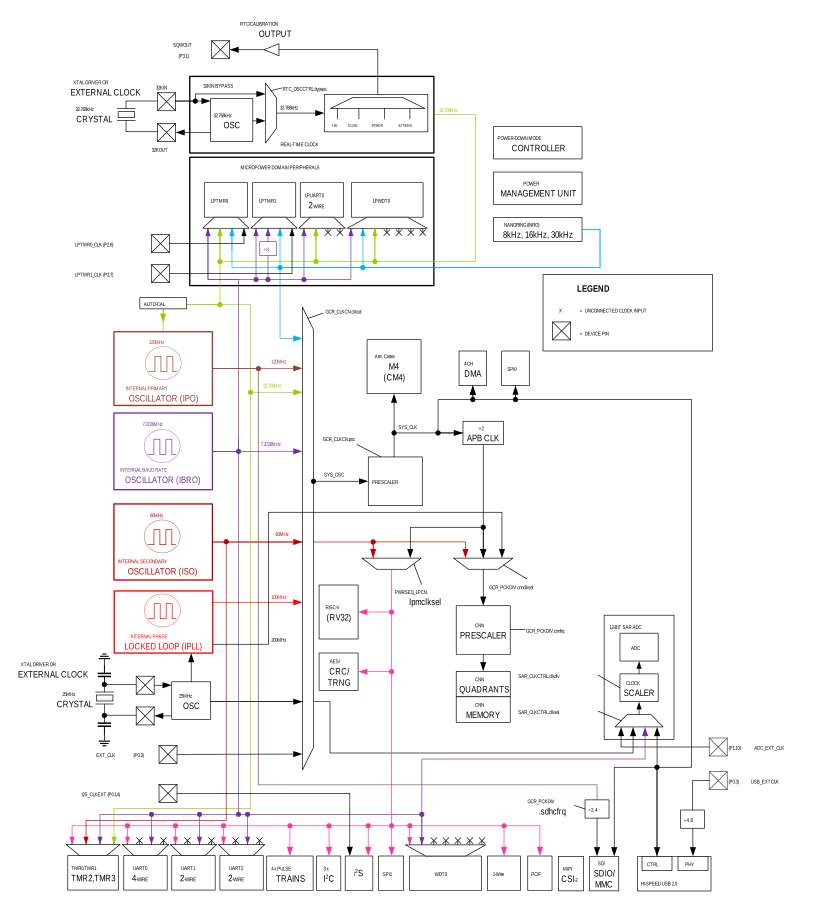
Multiple clock sources can be selected as the system clock:
- Internal phase-locked loop (IPLL) provides 100MHz and 200MHz clock sources
- Internal primary oscillator (IPO) at a nominal frequency of 120MHz
- Internal secondary oscillator (ISO) at a nominal frequency of 60MHz
- Configurable internal nanoring oscillator (INRO) at 8kHz, 16kHz, or 30kHz
- External RTC oscillator at 32.768kHz (ERTCO) (external crystal required)
- Internal baud rate oscillator at 7.3728MHz (IBRO)
- External square-wave clock up to 80MHz
There are multiple external clock inputs:
- LPTMR0 and LPTMR1 can be clocked from unique external sources.
- I2S can be be clocked from its own external source.
- USB can be clocked from its own external source.
Most GPIO pins share both a firmware-controlled I/O function and one or more alternate functions associated with peripheral modules. Pins can be individually enabled for GPIO or peripheral special function use. Configuring a pin as a special function usually supersedes its use as a firmware-controlled I/O. Although this multiplexing between peripheral and GPIO functions is usually static, it can also be done dynamically. The electrical characteristics of a GPIO pin are identical whether the pin is configured as an I/O or special function, except where explicitly noted in the Electrical Characteristics tables.
In GPIO mode, pins are logically divided into ports of 32 pins. Each pin of a port has an interrupt function that can be independently enabled, and configured as a level- or edge-sensitive interrupt. All GPIOs of a given port share the same interrupt vector.
When configured as GPIO, the following features are provided. The features can be independently enabled or disabled on a per-pin basis.
- Configurable as input, output, bidirectional, or high impedance
- Optional internal pull-up resistor or internal pull-down resistor when configured as input
- Exit from low-power modes on rising or falling edge
- Selectable standard- or high-drive modes
The MAX78002 provides up to 60 GPIO pins. Caution is needed since Port 3 (P3.0 and P3.1 device pins) are configured in a different manner from the above description. Refer to the MAX78002 User Guide for details.
The MIPI CSI-2 is a low voltage interface suited for CMOS image sensors with the following features:
- D-PHY 2.1
- MIPI Alliance Standard for Camera Serial Interface 2 Version 2.1 compliant
- Implements all three CSI-2 MIPI Layers (Pixel to Byte packing, Low-Level Protocol, Lane Management)
- Receiver only
- Two data lanes, one clock lane
- Supports high speed (4.5+ Gbps) D-PHY operation
- Support for all CSI-2 data types
- Error correction support
The 12-bit successive approximation register (SAR) ADC provides an external reference input and a single-ended input multiplexer. The multiplexer selects an input channel from one of the eight external analog input signals (AIN0–AIN7) or the internal power supply inputs.
The reference for the ADC can be:
- External VREF input
- Internal 1.25V or 2.048V selectable
An optional feature allows samples captured by the ADC to be automatically compared against user-programmable high and low limits. Up to four channel limit pairs can be configured in this way. The comparison allows the ADC to trigger an interrupt (and potentially wake the CPU from a power mode) when a captured sample goes outside the preprogrammed limit range. Since this comparison is performed directly by the sample limit monitors, it can be performed even while the CPU is in SLEEP, LOW POWER, or MICRO POWER mode. The eight AIN[7:0] inputs can be configured as four pairs and deployed as four independent comparators.
The ADC measures the following voltages:
- AIN[7:0] up to 3.3V
- VBAT
- VSS
- VCOREA
- VCOREB
- 2.5V internal LDO
- 0.9V internal LDO
- VDDB
- VDDA
- Internal die temperature sensor output
The eight AIN[7:0] inputs can be configured as four pairs and deployed as four independent comparators with the following features:
- Comparison events can trigger interrupts
- Events can wake the CM4 from SLEEP, LOW POWER, MICRO POWER, STANDBY, or BACKUP operating modes
- Can be active in all power modes
The power management unit (PMU) provides high-performance operation while minimizing power consumption. It exercises intelligent, precise control of power distribution to the CPUs and peripheral circuitry.
The PMU provides the following features:
- User-configurable system clock
- Automatic enabling and disabling of crystal oscillators based on power mode
- Multiple power domains
- Fast wake-up of powered-down peripherals when activity detected
- Optional control of external switches to provide the CNN with dedicated power from an external source
This mode consumes less power, but wakes faster because the clocks can optionally be enabled.
The device status is as follows:
- CM4 is asleep.
- RV32 is asleep.
- CNN quadrants and memory are configurable.
- Peripherals are on.
- Standard DMA is available for optional use.
This mode is suitable for running the RV32 processor to collect and move data from enabled peripherals.
The device status is as follows:
- The CM4, SRAM0, SRAM1, SRAM2, and SRAM3 are in state retention.
- CNN quadrants and memory are configurable and active.
- The RV32 can access the SPI, all UARTS, all timers, I2C, 1-Wire, pulse train engines, I2S, CRC, AES, TRNG, PCIF, and comparators, as well as SRAM4, SRAM5, SRAM6, and SRAM7. SRAM7 can be configured to operate as RV32 instruction cache.
- The transition from LOW POWER mode to ACTIVE mode is faster than the transition from BACKUP mode because system initialization is not required.
- The DMA can access flash.
- IPO and IPLL can be optionally powered down.
- The following oscillators are enabled:
- IBRO
- ERTCO
- INRO
- ISO
This mode is used for extremely low power consumption while using a minimal set of peripherals to provide wakeup capability.
The device status is as follows:
- Both CM4 and RV32 are state retained. System state and all SRAM is retained.
- CNN quadrants are powered off.
- CNN memory provides selectable retention.
- The GPIO pins retain their state.
- All non-MICRO POWER peripherals are state retained.
- The following oscillators are powered down:
- IPO
- IPLL
- ISO
- The following oscillators are enabled:
- IBRO
- ERTCO
- INRO
- The following MICRO POWER mode peripherals are available to wake up the device:
- LPUART0
- WWDT1
- All four low-power analog comparators
This mode is used to maintain the system operation while keeping time with the RTC.
The device status is as follows:
- Both CM4 and RV32 are state retained. System state and all SRAM are retained.
- CNN quadrants are powered off.
- CNN memory provides selectable retention.
- GPIO pins retain their state.
- All peripherals are state retained.
- The following oscillators are powered down:
- IPO
- IPLL
- ISO
- IBRO
- The following oscillators are enabled:
- ERTCO
- INRO
This mode is used to maintain the system RAM. The device status is as follows:
- CM4 and RV32 are powered off.
- SRAM0 thru SRAM7 can be configured to be state retained as per Table 1.
- CNN memory provides selectable retention.
- All peripherals are powered off.
The following oscillators are powered down:
- IPO
- IPLL
- ISO
- IBRO
The following oscillators are enabled:
- ERTCO
- INRO
| RAM BLOCK | RAM SIZE |
| SRAM0 | 32KB + ECC |
| SRAM1 | 32KB |
| SRAM2 | 64KB |
| SRAM3 | 64KB |
| SRAM4 | 64KB |
| SRAM5 | 64KB |
| SRAM6 | 48KB |
| SRAM7 | 16KB |
This mode is used during product level distribution and storage. The device status is as follows:
- CM4 and RV32 are powered off.
- All peripherals and SRAM are powered down.
- All oscillators are powered down.
- There is no data retention in this mode, but values in flash memory are preserved.
- Voltage monitors are operational.
The sources of wakeup from the SLEEP, LOW POWER, MICRO POWER, STANDBY, BACKUP, and POWER DOWN operating modes are summarized in Table 2.
| OPERATING MODE | WAKEUP SOURCE |
| SLEEP | Any enabled peripheral with interrupt capability; RSTN |
| LOW POWER (LPM) | SPI0, I2S, I2C, UARTs, timers, watchdog timers, wakeup timer, all comparators, RTC, GPIOs, RSTN, and RV32 |
| MICRO POWER (μPM) | All comparators, LPUART, LPTMR1, LPTIMER2, LPWDT0, RTC, wakeup timer, GPIOs, and RSTN |
| STANDBY | RTC, wakeup timer, GPIOs, CMP0, and RSTN |
| BACKUP | RTC, wakeup timer, GPIOs, CMP0, and RSTN |
| POWER DOWN (PDM) | P3.0, P3.1, and RSTN |
An RTC keeps the time of day in absolute seconds. The 32-bit seconds register can count up to approximately 136 years and be translated to calendar format by application software.
The RTC provides a time-of-day alarm that can be programmed to any future value between 1 second and 12 days. When configured for long intervals, the time-of-day alarm can be used as a power-saving timer, allowing the device to remain in an extremely low-power mode, but still awaken periodically to perform assigned tasks. A second independent 32-bit 1/4096 subsecond alarm can be programmed with a tick resolution of 244μs. Both can be configured as recurring alarms. When enabled, either alarm can cause an interrupt or wake the device from most low-power modes.
The time base is generated by a 32.768kHz crystal or an external clock source that must meet the electrical/timing requirements in the Electrical Characteristics table.
The RTC calibration feature provides the ability for user software to compensate for minor variations in the RTC oscillator, crystal, temperature, and board layout. Enabling the SQWOUT alternate function outputs a timing signal derived from the RTC. External hardware can measure the frequency and adjust the RTC frequency in increments of ±127ppm with 1ppm resolution. Under most circumstances, the oscillator does not require any calibration.
General-purpose, 32-bit timers provide timing, capture/compare, or generation of pulse-width modulated (PWM) signals with minimal software interaction.
The timer provides the following features:
- 32-bit up/down autoreload
- Programmable prescaler
- PWM output generation
- Capture, compare, and capture/compare capability
- External pin multiplexed with GPIO for timer input, clock gating, or capture
- Timer output pin
- TMR0–TMR3 can be configured as 2 × 16-bit general-purpose timers
- Timer interrupt
The MAX78002 provides six 32-bit timers (TMR0, TMR1, TMR2, TMR3, LPTMR0, and LPTMR1). LPTMR0 and LPTMR1 are capable of operation in the SLEEP, LOW POWER, and MICRO POWER modes.
I/O functionality is supported for all of the timers. Note that the function of a port can be multiplexed with other functions on the GPIO pins, so it might not be possible to use all of the ports depending on the device configuration. See Table 3 for individual timer features.
| INSTANCE | REGISTER ACCESS NAME | SINGLE 32 BIT | DUAL 16 BIT | SINGLE 16 BIT | POWER MODE | CLOCK SOURCE | |||||||
| PCLK | ISO | IBRO | INRO | ERTCO | LPTMR0_CLK | LPTMR1_CLK | |||||||
| TMR0 | TMR0 | Yes | Yes | No | ACTIVE, SLEEP, LOW POWER |
Yes | Yes | Yes | No | Yes | No | No | |
| TMR1 | TMR1 | Yes | Yes | No | ACTIVE, SLEEP, LOW POWER |
Yes | Yes | Yes | No | Yes | No | No | |
| TMR2 | TMR2 | Yes | Yes | No | ACTIVE, SLEEP, LOW POWER |
Yes | Yes | Yes | No | Yes | No | No | |
| TMR3 | TMR3 | Yes | Yes | No | ACTIVE, SLEEP, LOW POWER |
Yes | Yes | Yes | No | Yes | No | No | |
| LPTMR0 | TMR4 | No | No | Yes | ACTIVE, SLEEP, LOW POWER, MICRO POWER |
No | No | Yes | Yes | Yes | Yes | No | |
| LPTMR1 | TMR5 | No | No | Yes | ACTIVE, SLEEP, LOW POWER, MICRO POWER |
No | No | Yes | Yes | Yes | No | Yes | |
Microcontrollers are often used in harsh environments where electrical noise and electromagnetic interference (EMI) are abundant. Without proper safeguards, these hazards can disturb device operation and corrupt program execution. One of the most effective countermeasures is the windowed watchdog timer (WDT), which detects runaway code or system unresponsiveness.
The WDT is a 32-bit, free-running counter with a configurable prescaler. When enabled, the WDT must be periodically reset by the application software. Failure to reset the WDT within the user-configurable timeout period indicates that the application software is not operating correctly and results in a WDT timeout. A WDT timeout can trigger an interrupt, system reset, or both. Either response forces the instruction pointer to a known good location before resuming instruction execution. The windowed timeout period feature provides more detailed monitoring of system operation, requiring the WDT to be reset within a specific window of time. See Table 4 for individual timer features.
The MAX78002 provides two instances of the watchdog timer—WDT0 and LPWDT0.
| INSTANCE NAME | REGISTER ACCESS NAME | POWER MODE | CLOCK SOURCE | ||||
| PCLK | IBRO | INRO | ERTCO | ||||
| WDT0 | WDT0 | ACTIVE, SLEEP, LOW POWER |
Yes | Yes | No | No | |
| LPWDT0 | WDT1 | ACTIVE, SLEEP, LOW POWER, MICRO POWER |
No | Yes | Yes | Yes | |
Multiple, independent pulse train generators can provide either a square-wave or a repeating pattern from 2 to 32 bits in length. Any single pulse train generator or any desired group of pulse train generators can be synchronized at the bit level, allowing for multibit patterns. Each pulse train generator is independently configurable.
The pulse train generators provide the following features:
- Independently enabled
- Safe enable and disable for pulse trains without bit banding
- Multiple pin configurations allow for flexible layout
- Pulse trains can be started/synchronized independently or as a group
- Frequency of each enabled pulse train generator is also set separately, based on a divide down (such as divide by 2, divide by 4, and divide by 8) of the input pulse train module clock
- Input pulse train module clock can be optionally configured to be independent from the system AHB clock
- Multiple repetition options
- Single shot (nonrepeating pattern of 2 to 32 bits)
- Pattern repeats user-configurable number of times or indefinitely
- Termination of one pulse train loop count can restart one or more other pulse trains
The pulse train engine feature is an alternate function associated with a GPIO pin. In most cases, enabling the pulse train engine function supersedes the GPIO function.
The MAX78002 provide up to four instances of the pulse train engine peripheral (PT[3:0]).
The I2C interface is a bidirectional, two-wire serial bus that provides a medium-speed communications network. It can operate as a one-to-one, one-to-many or many-to-many communications medium. These engines support Standard-mode, Fast-mode, Fast-mode Plus, and High-speed mode I2C speeds. It provides the following features:
- Controller or target mode operation
- Supports up to four different target addresses in target mode
- Supports standard 7-bit addressing or 10-bit addressing
- RESTART condition
- Interactive receive mode
- Tx FIFO preloading
- Support for clock stretching to allow slower target devices to operate on higher speed busses
- Multiple transfer rates
- Standard-mode: 100kbps
- Fast-mode: 400kbps
- Fast-mode Plus: 1000kbps
- High-speed mode: 3.4Mbps
- Internal filter to reject noise spikes
- Receiver FIFO depth of 8 bytes
- Transmitter FIFO depth of 8 bytes
The MAX78002 provides three instances of the I2C peripheral—I2C0, I2C1, and I2C2.
The I2S interface is a bidirectional, four-wire serial bus that provides serial communications for codecs and audio amplifiers compliant with the I2S Bus Specification, June 5, 1996. It provides the following features:
- Controller and target mode operation
- 8, 16, 24, and 32 bit frames
- Receive and transmit DMA support
- Wakeup on FIFO status (full/empty/threshold)
- Pulse density modulation support for receive channel
- Word select polarity control
- First bit position selection
- Interrupts generated for FIFO status
- Receiver FIFO depth of 32 bytes
- Transmitter FIFO depth of 32 bytes
The MAX78002 provides one instance of the I2S peripheral (I2S).
SPI is a highly configurable, flexible, and efficient synchronous interface among multiple SPI devices on a single bus. The bus uses a single clock signal and multiple data signals, and one or more target select lines to address only the intended target device. The SPI operates independently and requires minimal processor overhead.
The provided SPI peripherals can operate in either target or controller mode and provide the following features:
- SPI modes 0, 1, 2, or 3 for single-bit communication
- 3- or 4-wire mode for single-bit target device communication
- Full-duplex operation in single-bit, 4-wire mode
- Dual and quad data modes supported
- Multiple target selects on some instances
- Multicontroller mode fault detection
- Programmable interface timing
- Programmable SCK frequency and duty cycle
- 32-byte transmit and receive FIFOs
- Target select assertion and deassertion timing with respect to leading/trailing SCK edge
The MAX78002 provides two instances of the SPI peripheral—SPI0 and SPI1. See Table 5 for configuration options.
| INSTANCE | DATA | TARGET SELECT LINES | MAXIMUM FREQUENCY CONTROLLER MODE (MHz) | MAXIMUM FREQUENCY TARGET MODE (MHz) |
| SPI0 | 3-wire, 4-wire, dual, or quad data support | 3 | 60 | 60 |
| SPI1 | 3-wire, 4-wire, dual, or quad data support | 1 | 30 | 60 |
The universal asynchronous receiver-transmitter (UART, LPUART) interface supports full-duplex asynchronous communication with optional hardware flow control (HFC) modes to prevent data overruns. If HFC mode is enabled on a given port, the system uses two extra pins to implement the industry-standard request to send (RTS) and clear to send (CTS) flow control signaling. Each instance is individually programmable.
- 2-wire interface or 4-wire interface with flow control
- 8-byte send/receive FIFO
- Full-duplex operation for asynchronous data transfers
- Interrupts available for frame error, parity error, CTS, Rx FIFO overrun, and FIFO full/partially full conditions
- Automatic parity and frame error detection
- Independent baud-rate generator
- Programmable 9th-bit parity support
- Multidrop support
- Start/stop bit support
- Hardware flow control using RTS/CTS
- 12.5Mbps for UART maximum bit rate
- 1.85Mbps for LPUART maximum bit rate
- Two DMA channels can be connected (read and write FIFOs)
- Programmable word size (5 bits to 8 bits)
The MAX78002 provides four instances of the UART peripheral—UART0, UART1, UART2, and LPUART0. LPUART0 is capable of operation in the SLEEP, LOW POWER, and MICRO POWER modes. See Table 6 for configuration options.
| INSTANCE NAME | REGISTER ACCESS NAME | HARDWARE FLOW CONTROL | POWER MODE | CLOCK SOURCE | |||
| PCLK | IBRO | ERTCO | |||||
| UART0 | UART0 | Yes | ACTIVE, SLEEP, LOW POWER |
Yes | Yes | No | |
| UART1 | UART1 | No | ACTIVE, SLEEP, LOW POWER |
Yes | Yes | No | |
| UART2 | UART2 | No | ACTIVE, SLEEP, LOW POWER |
Yes | Yes | No | |
| LPUART0 | UART3 | No | ACTIVE, SLEEP, LOW POWER, MICRO POWER |
No | Yes | Yes | |
Analog Device's 1-Wire bus consists of one signal that carries data and also supplies power to the target devices and a ground return. The bus controller communicates serially with one or more target devices through the bidirectional, multidrop 1-Wire bus. The single-contact serial interface is ideal for communication networks requiring minimal interconnection.
The provided 1-Wire controller supports the following features:
- Single contact for control and operation
- Unique factory identifier for any 1-Wire device
- Multiple device capability on a single line
The OWM supports both standard (15.6kbps) and overdrive (110kbps) speeds.
The standard DMA controller allows automatic one-way data transfer between two entities. These entities can be either memories or peripherals. The transfers are done without using CPU resources. The following transfer modes are supported:
- 4-channel
- Peripheral to data memory
- Data memory to peripheral
- Data memory to data memory
- Event support
All DMA transactions consist of an AHB burst read into the DMA FIFO followed immediately by an AHB burst write from the FIFO.
The MAX78002 provides one instance of the standard DMA controller.
The dedicated hardware-based AES engine supports the following algorithms:
- AES-128
- AES-192
- AES-256
The AES keys are automatically generated by the engine and stored in dedicated flash to protect against tampering. Key generation and storage is transparent to the user.
The device provides a non-deterministic entropy source that can be used to generate cryptographic seeds or strong encryption keys as part of an overall framework for a secure customer application.
Software can use random numbers to trigger asynchronous events that add complexity to program execution to thwart replay attacks or key search methodologies.
The TRNG can support the system-level validation of many security standards. Analog Devices will work directly with the customer’s validation laboratory to provide the laboratory with any required information. Contact Analog Devices for details of compliance with specific standards.
A cyclic redundancy check (CRC) hardware module provides fast calculations and data integrity checks by application software. It supports a user-defined programmable polynomial up to 32-bits. Direct memory access copies data into the CRC module so that CRC calculations on large blocks of memory are performed with minimal CPU intervention. Examples of common polynomials are depicted in Table 7.
| ALGORITHM | POLYNOMIAL EXPRESSION |
| CRC-32-ETHERNET | x32 + x26 + x23 + x22 + x16 + x12 + x11 + x10 + x8 + x7 + x5 + x4 + x2 + x1 + x0 |
| CRC-CCITT | x16 + x12 + x5 + x0 |
| CRC-16 | x16 + x15 + x2 + x0 |
| USB DATA | x16 + x15 + x2 + x0 |
| PARITY | x1 + x0 |
The bootloader allows loading and verification of program memory through a serial interface. It provides the following features:
- Bootloader interface through UART
- Program loading of Motorola® SREC format files
- Permanent lock state prevents altering or erasing program memory
- Access to the USN for device or customer application identification
- Disabling of the SWD interface to block debug access port functionality
The bootloader interface pins listed in Table 8 must be accessible to the host to use the bootloader.
The serial wire debug interface is used for code loading and ICE debug activities for the CM4. A JTAG interface is provided for the RV32. All devices in mass production have the debugging/development interface enabled.
Motorola is a registered trademark of Motorola Trademark Holdings, LLC.