The MAX40000 and MAX40001 are ideally suited for use with most battery-powered systems. Table 1 lists Alkaline and Lithium-Ion batteries with capacities and approximate operating times for MAX40000 and MAX40001, assuming nominal conditions.
Internal Hysteresis
Many comparators oscillate in the linear region of operation because of noise or undesired parasitic feedback. This tends to occur when the voltage on one input is equal or very close to the voltage on the other input. The MAX40000/MAX40001 have internal 2.5mV hysteresis to counter parasitic effects and noise.
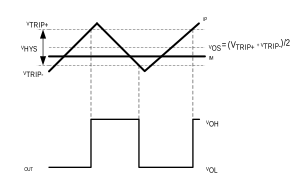
The hysteresis in a comparator creates two trip points: one for upper threshold (VTRIP+) and one for lower threshold (VTRIP-) for voltage transitions on the input signal (Figure 1). The difference between the trip points is the hysteresis band (VHYS). When the comparator’s input voltages are equal, the hysteresis effectively causes one comparator input to move quickly past the other, thus taking the input
out of the region where oscillation occurs. Figure 1 illustrates the case in which IM has a fixed voltage applied, and IP is varied. If the inputs were reversed, the figure would be the same, except with an inverted output.
Adding External Hysteresis
In applications requiring more than the internal 2.5mV hysteresis of the devices, additional hysteresis can be added with two external resistors. Since these comparators are intended to use in very low-power systems, care must be taken to minimize power dissipation in the additional circuitry.
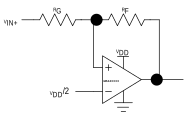
Regardless of which approach is employed to add external hysteresis, the external hysteresis will be VDD dependent. Over the full discharge range of battery-powered systems, the hysteresis can change as much as 40%. Figure 2 shown below is simplest circuit for adding external hysteresis. In this example, the hysteresis is defined by:
Where RG is the source resistance and RF is the feedback resistance. Because the comparison threshold is 1/2 VDD, the MAX40000 was chosen for its push-pull output and lack of reference. This provides symmetrical hysteresis around the threshold.
Figure 1. Hysteresis Band
Table 1. Battery Applications Using MAX40000 and MAX40001
BATTERY TYPE
RECHARGEABLE
VINITIAL
(V)
VEND-OF-LIFE
(V)
CAPACITY, AA
SIZE (mAh)
MAX40000/MAX40001 OPERATING TIME (hr)
Alkaline (2 Cells)
No
3.0
1.8
2000
1.8 x 10⁶
Lithium-Ion (1 Cell)
Yes
3.5
2.7
1000
0.9 x 10⁶
Output Considerations
In most cases, the push-pull output of MAX40000 is best for external hysteresis. The open-drain output of the MAX40001 can be used, but the effect of the feedback network and pullup resistor on the actual output high voltage must be considered.
Component Selection
Because the MAX40000/MAX40001 are intended for very low power-supply systems, the highest impedance circuits should be used wherever possible. The offset error due to input-bias current is proportional to the total impedance seen at the input. For example, selecting components for Figure 2, with a target of 50mV hysteresis, a 5V supply, and choosing an RF of 10MΩ gives RG as 100kΩ. The total impedance seen at IN+ is therefore 10MΩ || 100kΩ, or 99kΩ. The maximum input bias current of MAX40000/MAX40001 is 1nA; therefore, the error due to source impedance is less than 100μV.
Board Layout and Bypassing
Power-supply bypass capacitors are not typically needed, but use 100nF bypass capacitors close to the device’s supply pins when supply impedance is high, supply leads are long, or excessive noise is expected on the supply lines. Minimize signal trace lengths to reduce stray capacitance. A ground plane and surface-mount components are recommended. If the REF pin is decoupled, use a new low-leakage capacitor.
Logic-Level Translator
The Typical Application Circuit shows an application that converts 5V logic to 3V logic levels. The MAX40001 is powered by the +5V supply voltage to VDD, and the pullup resistor for the MAX40001’s open-drain output is connected to the +3V supply voltage. This configuration allows the full 5V logic swing without creating overvoltage on the 3V logic inputs. For 3V to 5V logic-level translations, simply connect the +3V supply voltage to VDD and the +5V supply voltage to the pullup resistor.